
He Guarded the House That Broke Him. Then a Stranger Opened the Cage
The call came from someone passing through the countryside.
A visitor. Not a neighbor. Not family. Just someone who noticed something felt wrong.
A dog was locked inside a house.
Inside a cage that looked far too small.
Inside a space no one seemed to visit anymore.
By the time rescuer Bruno Jelovic arrived, the house was empty. The owner was gone. The door stood closed. What waited inside was a silence that felt practiced.
This was not a rumor or a secondhand report. What happened next was recorded and later shared by the rescue team themselves.
Behind that door was Leo.
And in the moments that followed, Leo would show a kind of loyalty that made even experienced rescuers stop and question what neglect does to an animal’s sense of trust.
The house that forgot he existed
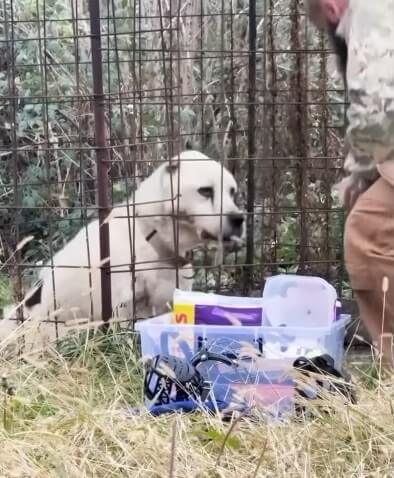
Leo was a large male dog, alone inside a filthy, cramped cage. His body was thin to the point where his bones shaped the outline of his skin. Dirt clung to his coat. The smell of neglect filled the room.
Bruno remembers stepping inside and realizing the dog did not recognize him.
“He didn’t recognize me and immediately started barking,” he said.
The sound was not rage. It was not panic. It was defense.
“He was trying to defend his cruel owner’s house,” Bruno explained. “He remained loyal despite the pain and suffering.”
Leo had been surviving in place, guarding a home that never guarded him back.
Bruno later admitted what crossed his mind as he stood there watching the dog struggle to stand.
“I wondered how Leo had managed to survive until now.”
Why dogs still defend the place that harmed them
Dogs do not measure fairness. They measure familiarity.
When a dog spends long periods confined to one space, especially alone, that space becomes the only constant they know.
According to the American Kennel Club, extended isolation and confinement can trigger stress responses tied to fear, uncertainty, and confusion rather than aggression. Barking, freezing, and guarding behavior often reflect an attempt to control the only environment the dog understands.
Leo’s bark was not rejection.
It was recognition of routine.
This is why rescues often pause before acting.
A frightened dog does not need force.
They need predictability.
Choosing patience instead of control

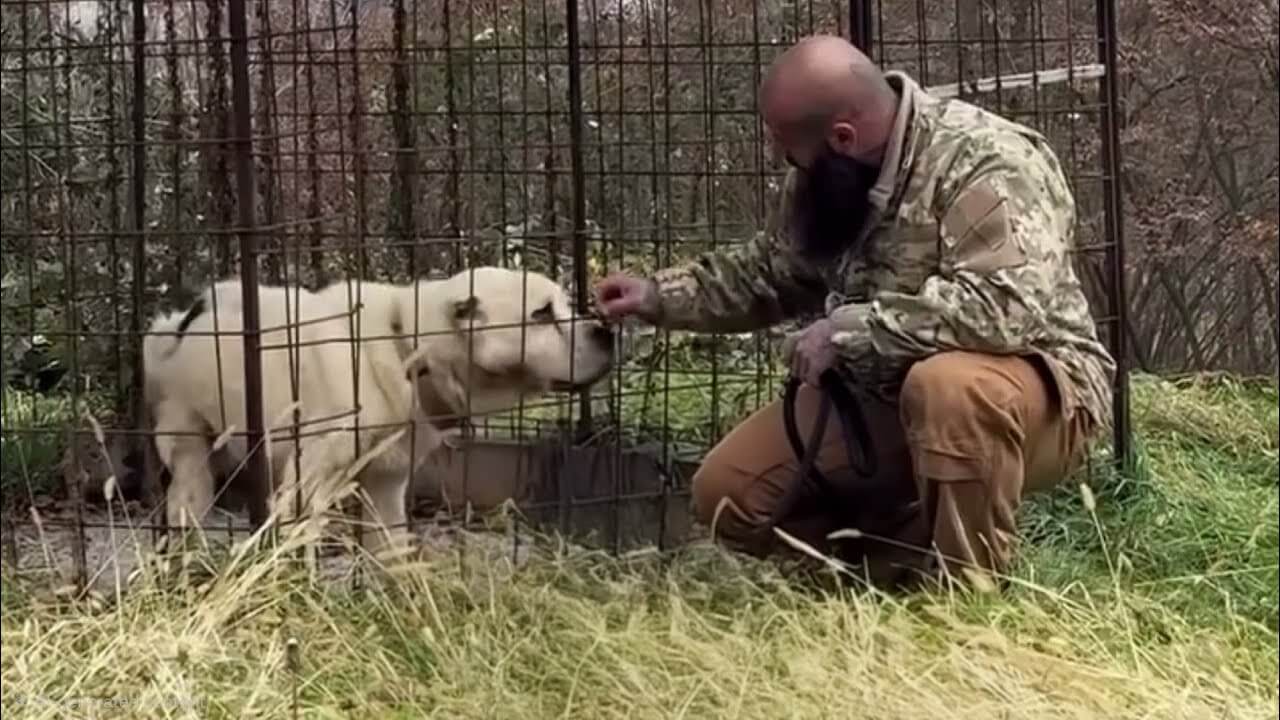
Bruno did not reach for Leo right away.
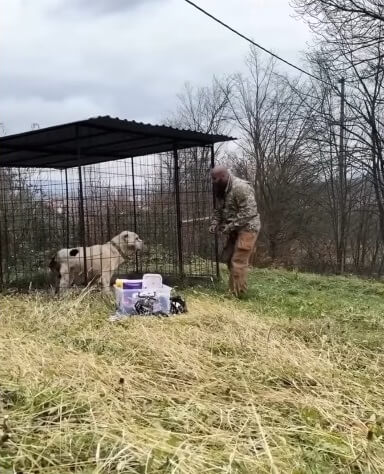
He brought food. He stayed low. He spoke quietly. He waited.
“Perhaps he had never been treated kindly before,” he said.
The cage door stayed open. Leo stayed still. The moment stretched.
Then Bruno reached out.
Leo hesitated, caught between fear and something unfamiliar. After a few minutes of gentle touch, his body softened. He did not lunge. He did not retreat.
“He didn’t try to escape. He didn’t try to hurt anyone,” Bruno said. “He just sat down, as if he knew that the day of salvation had arrived.”
Leo stepped out of the cage slowly. Freedom did not come with excitement. It came with caution.
The long drive and the limits of shelter space

The trip to safety took hours. Leo was weak. He was hungry. He was quiet.
He did not panic in the car. He did not resist handling. He watched.
The destination was a shelter already stretched thin.
“The shelter was completely full,” Bruno said. “Working there had become very difficult.”
Shelter overcrowding is not rare. Humane World for Animals reports that many shelters face sustained capacity strain, leading to longer stays for dogs who are older, larger, or medically fragile.
That night, Bruno made a decision no one wants to make.
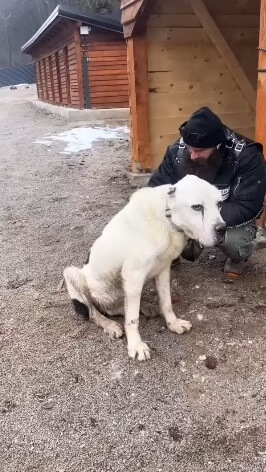
Leo slept in a small hut near the shelter. Temporary. Improvised. Safe.
The next day, Bruno and his team built him a wooden shelter of his own. It was simple. It was quiet. It had fresh air.
For Leo, it was the first space that belonged to him.
The dog adopters passed by
Leo did not attract attention.
He was large. Older. Calm to the point of being invisible.
“His chances of adoption were practically nonexistent,” Bruno said. “Everyone was avoiding him.”
Best Friends Animal Society has documented that large and senior dogs often remain in shelters longer due to housing rules, size bias, and adoption preferences, even when they are healthy and social.
Days passed. Other dogs left. Leo stayed.
Commitment without ownership
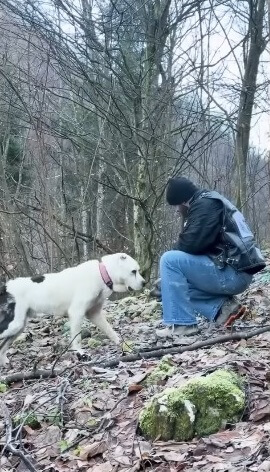
Bruno wanted to adopt Leo himself. He knew what that would mean.
“I couldn’t,” he said. “That would take resources away from the other dogs who also needed help.”
So he chose something harder.
“I visited him every day,” Bruno said. “I took him for walks in the woods. No matter how busy I was, I always made time for him.”
There were no cameras during those walks. No announcements. Just consistency.
Leo learned routines. He learned voices. He learned that someone would return.
“I promise you, Leo, that I will always be by your side,” Bruno said. “I will never let you suffer from loneliness. I will never let you suffer from neglect.”
Exhaustion did not change that promise.
Where Leo’s story stands today
As of the video shared by the Dog Haven channel, Leo remained safe, cared for, and consistently visited. His story was not framed as finished. It was framed as protected.
This story is not about a fast ending.
It is about what happens when someone refuses to look away.
Leo guarded a house that never protected him.
He trusted a stranger when he had every reason not to.
He reminded people that quiet dogs are often carrying the heaviest stories.
If this story stayed with you, sharing it helps more than it seems.
Awareness reaches the dogs still waiting behind closed doors. Sometimes that is where rescue begins.
Also check out these rescues:
She Lay Frozen in Trash, Waiting to Die. What Santa Did Next Left Rescuers in Tears
From Trash to Treasure: The Dog Who Went From Dumped to Deeply Loved


