
She Was Found Choking in a Ditch — Why This Mother Dog Refused to Leave

The call came through in a trembling voice.
A young girl said there was a dog lying in a ditch. She sounded scared, the kind of fear that comes from seeing something that does not make sense and knowing time matters.
From the moment rescuers were alerted, it was clear this was a real emergency. The report pointed to a dog struggling to breathe, unable to move, and exposed to the elements.
What they found would later become a documented rescue, one that explained not only how badly she was hurt, but why she refused to leave the place that nearly killed her.
A Rope, a Ditch, and a Dog Struggling to Breathe
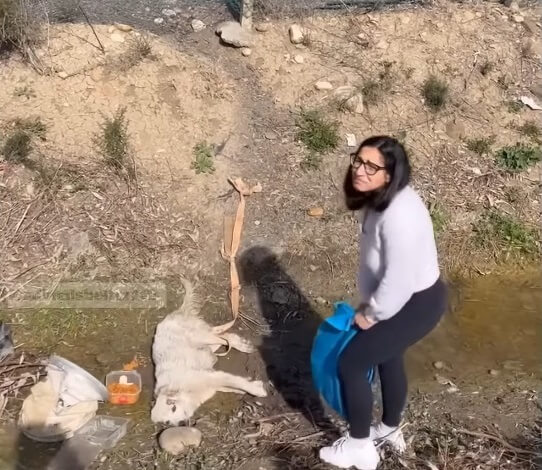
Lying at the bottom of the ditch was a filthy, exhausted mother dog. A rope was tied tightly around her neck, cutting into her skin and restricting her breathing. Every small movement looked painful. Every breath seemed forced.
She tried to lift her head and failed. Her body trembled. Panic showed in her eyes.
Fear had made her defensive. When rescuers approached, she growled and pulled away. Not out of aggression, but out of learned survival. Somewhere in her past, human hands had caused pain, and her body remembered.
This response is common in dogs who have been abused or trapped. Guidance from the ASPCA explains that when fearful dogs are cornered or trapped, they may shift from avoidance to self-protection as stress overwhelms them.
The situation demanded patience.
Earning Her Trust Without Touching the Fear
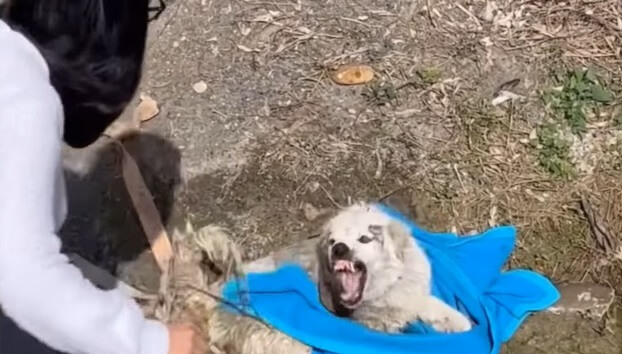
Rescuers spoke softly and moved slowly. They avoided sudden gestures. They stayed low. Nothing was rushed.
She did not understand help yet. She only knew she was trapped, hurt, and struggling to breathe.
When exhaustion finally overtook her, her body collapsed into the ditch. That moment shifted the focus from approach to survival.
A protective mat was used to move her safely. For the safety of everyone involved, including the veterinary team, she was gently muzzled. Veterinary guidance from the American Animal Hospital Association explains that muzzles can be a humane tool when pain or fear could trigger a defensive reaction.
With her body supported and her airway stabilized, her breathing slowly began to ease.
The rope around her neck remained, tight and unmoved, a quiet sign that what happened before this moment was not accidental.
The X-Ray That Changed the Rescue
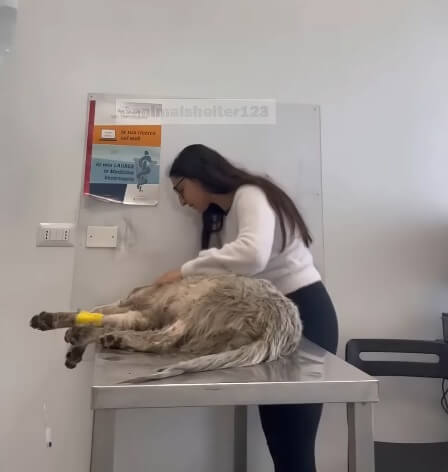
Once stabilized, she was taken for imaging.
X-rays revealed fractures in her leg and pelvis, injuries consistent with serious trauma. Her body had absorbed more damage than anyone first realized.
Then the veterinarians noticed something else.
She was nursing.
That detail changed everything.
A nursing mother meant puppies were waiting somewhere. Hungry. Cold. Alone.
And it explained what no one had understood before.
Why She Stayed in the Ditch
Despite the rope around her neck and the pain in her body, she had not tried to drag herself away. She had not wandered. She had not disappeared.
She stayed close.
Maternal instinct can outweigh fear and injury. In hurt animals, that instinct often keeps mothers near the last place they left their young, even when staying puts them at risk.
The team knew they had to find the puppies quickly.
Following the Trail Back
Two local farmers shared what they had seen. They remembered the dog returning to the same area again and again.
Rescuers followed their guidance into the surrounding fields.
Then they heard it.
Faint cries carried through the cold night air.
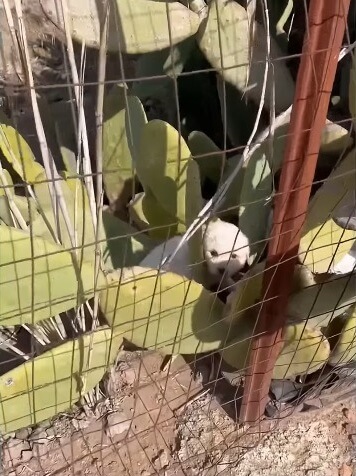
The first puppy was found alone, waiting. Then a second, wandering nearby. The third was hidden deep inside a cactus bush, out of sight and protected only by instinct.
Reaching that puppy meant torn gloves and bleeding hands. Hunger finally drew the small body forward.
Three puppies. Alive. Waiting for a mother who had not abandoned them.
Medical Care and a Careful Recovery

Back at the clinic, the mother dog underwent surgery. Her pelvis and leg were stabilized with splints. Movement was limited. Pain was managed carefully.
Veterinary research published through PubMed Central notes that most animals (75%) with pelvic fractures will recover without surgery when supported and monitored closely.
Time became the main treatment.
As days passed, her breathing steadied. Her strength returned in small steps. She rested more easily.
When she was reunited with her puppies, her body relaxed in a way it had not since the rescue.
Only then did the full picture come together.
She had stayed in the ditch because leaving meant moving farther away from her babies.
From Fear to Family

As her body healed, her behavior changed.
Fear softened first. Curiosity followed. Trust came slowly.
She was named Blanca.
Her puppies grew stronger beside her. She learned to walk again. The tension in her posture eased. What remained was a gentle, attentive mother whose focus had never shifted.
Today, Blanca and her puppies are safe under the care of Casa Speranza, with their recovery shared through Animal Shelter as part of the rescue team’s publicly documented updates.
Why Stories Like This Still Matter
This rescue was not about luck.
It was about noticing.
Injured animals do not always cry out. Sometimes they lie still in ditches, waiting for pain to pass or for help that may never come.
Guidance from the Companion Animal Parasite Council shows that trauma, fear, and physical injury often occur together in neglected animals, and recovery depends on early intervention and careful handling.
Somewhere in that ditch, Blanca made a choice no one saw at first.
She stayed close to protect her babies.
What saved her was not chance. It was someone hearing fear in a voice and deciding to act.
If this story stayed with you, sharing it could help the next injured animal be seen in time.
Other documented rescues have shown similar patterns of maternal protection and survival under extreme conditions. You can check them out below.
She Couldn’t Move, But She Refused to Let Go: The Mother Dog Who Fought Death for Her Six Puppies
She Walked Miles on Empty, Carrying a Secret That Broke Hearts


