
People Called Him a Monster for Years. Then Rescuers Learned the Truth
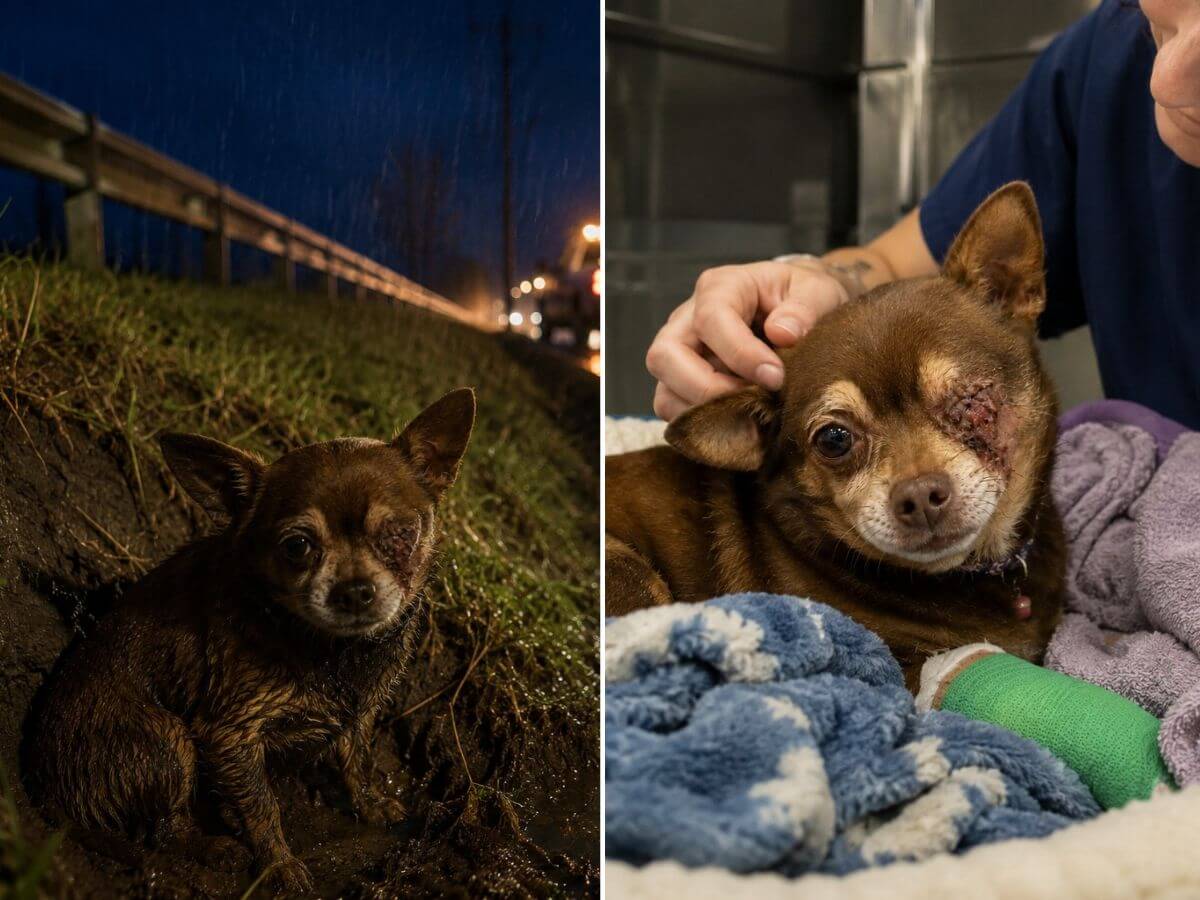
People crossed the street when they saw him.
Children pointed.
Adults whispered.
Some pulled their dogs closer and hurried away.
Others simply stared.
For nearly six years, Bruno lived with the kind of attention no animal should ever receive.
Not because he was dangerous.
Not because he was aggressive.
But because of the way he looked.
His face carried deep scars.
One side appeared uneven.
Old injuries had left permanent marks that made strangers uncomfortable before they ever learned his name.
Most people never stayed long enough to understand what had happened.
They looked once and made up their minds.
To them, Bruno wasn’t a dog.
He was something frightening.
Something broken.
Something they preferred not to be near.
What nobody understood was that every scar on Bruno’s face came from a battle he never chose.
Long before he became known as the dog people feared, Bruno was simply a survivor doing his best to keep going.
Then one rainy evening changed everything.
The Rainy Night That Changed Everything
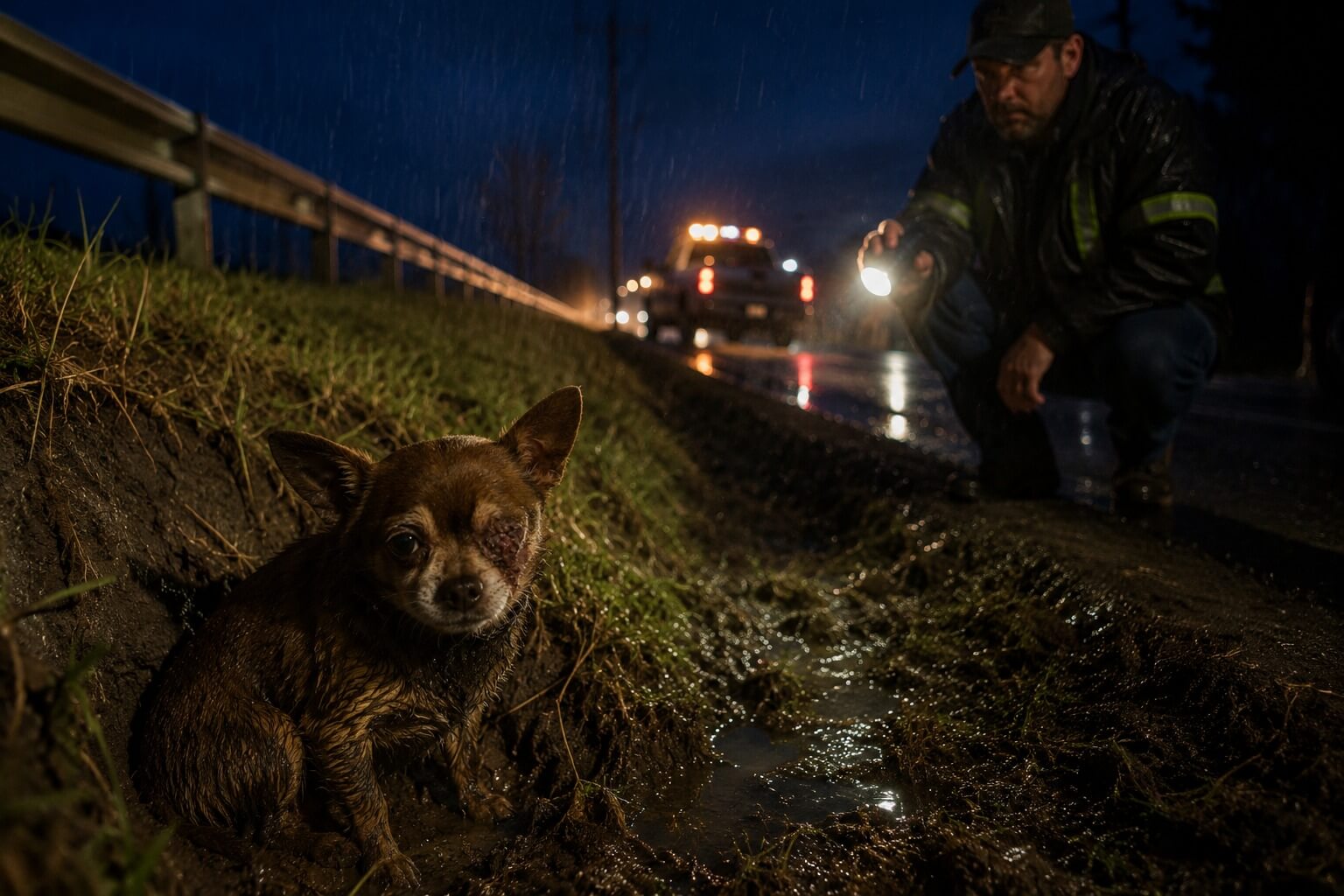
The call came in just after sunset.
Rain had been falling steadily across a quiet stretch of rural highway when a truck driver noticed something unusual near the shoulder of the road.
At first, he thought it was debris.
A dark shape partially hidden in wet grass.
Then he looked closer.
It was a dog.
A large dog.
Motionless.
The driver pulled over and grabbed a flashlight.
As he approached, the scene became harder to process.
The dog wasn’t moving.
His body lay twisted near a drainage ditch several feet from the pavement.
Mud covered his coat.
Rainwater pooled around him.
For a moment, the driver feared he was already too late.
Then he noticed the faint rise and fall of the dog’s chest.
Barely visible.
But enough.
The dog was still alive.
Emergency calls were placed immediately.
A rescue team rushed to the scene.
Nothing could have prepared them for what they found.
Bruno had been struck by a speeding vehicle.
The force of the impact had thrown him from the roadway and into the ditch below.
Blood stained the grass around him.
His muzzle had swollen so severely that it no longer looked natural.
Deep wounds stretched across his shoulder and chest.
One rear leg bent at an angle that instantly told rescuers something was terribly wrong.
Yet the injury that stayed with many of them wasn’t visible at all.
It was the way Bruno looked at them.
Exhausted.
Defeated.
As if he had spent every ounce of strength simply staying alive until help arrived.
When rescuers carefully lifted him onto a stretcher, a painful cry escaped his throat.
The sound cut through the rain.
Several people later admitted it was the moment that broke their hearts.
The pain was obvious.
The fear was obvious.
Still, Bruno never snapped.
Never growled.
Never fought the hands trying to save him.
He simply endured.
And allowed strangers to carry him toward a chance he almost never received.
Veterinarians Weren’t Sure He Could Survive
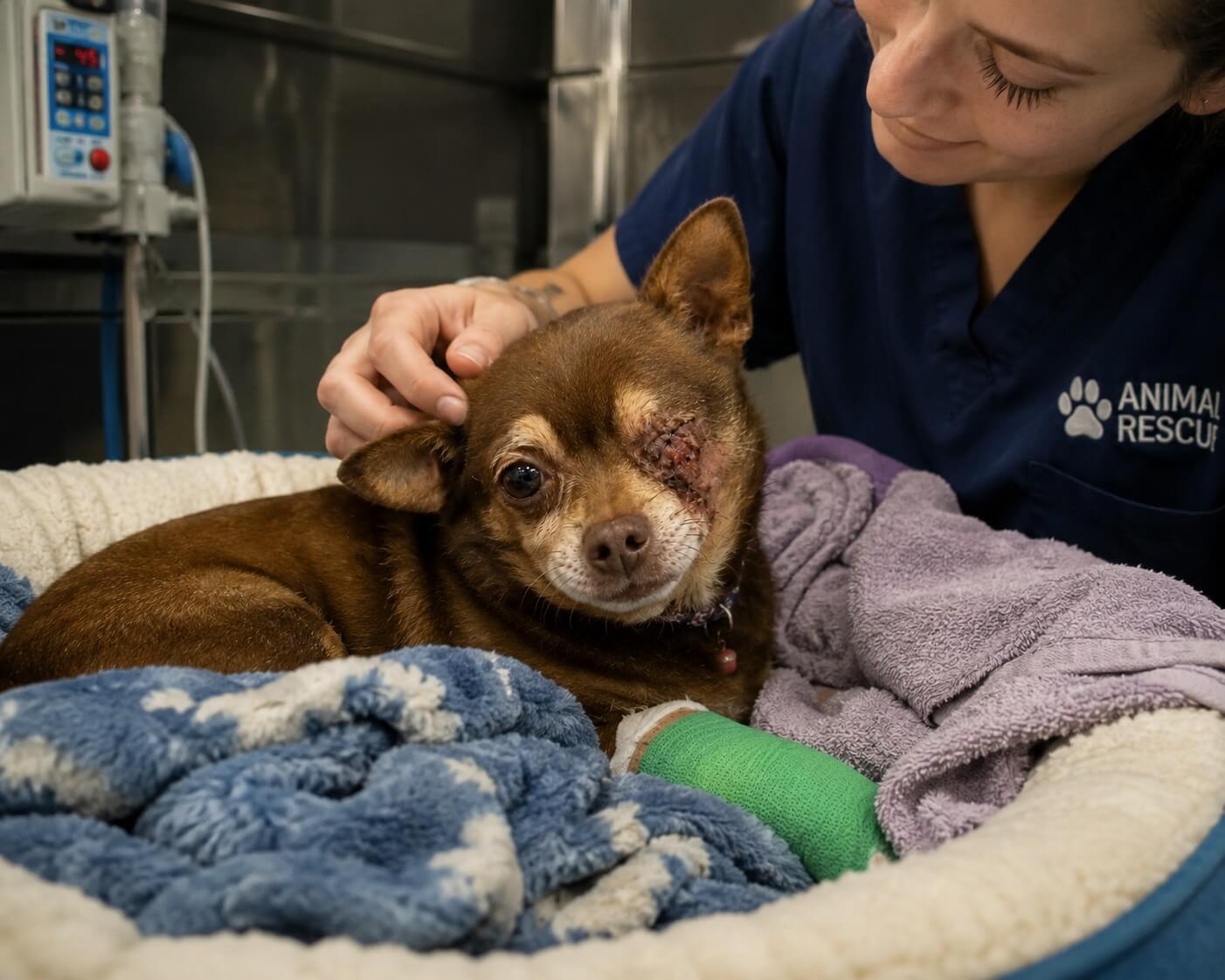
Bruno arrived at the emergency hospital in critical condition.
Veterinary teams moved quickly.
Every minute mattered.
He was rushed into imaging while staff stabilized his breathing and monitored signs of internal trauma.
The scans revealed what everyone feared.
His injuries were devastating.
A shattered jaw.
Multiple facial fractures.
A broken pelvis.
Three fractured ribs.
A severely damaged rear leg.
Extensive bruising throughout his body.
The list seemed to grow with every image specialists reviewed.
The room fell quiet.
Many of the veterinarians had spent years treating emergency cases.
They had seen dogs survive situations that seemed impossible.
Yet Bruno’s condition stood out.
Not because one injury was severe.
Because so many severe injuries existed at the same time.
Repairing them would require multiple surgeries.
Months of recovery.
Constant monitoring.
And even then, there were no guarantees.
Some quietly wondered whether his body could handle everything that lay ahead.
The question nobody wanted to ask hung in the air.
Was survival even possible?
Then Bruno answered it himself.
Every time someone walked past his kennel, they noticed the same thing.
His eyes followed them.
Every movement.
Every voice.
Every person who stopped to check on him.
He was weak.
Far too weak to stand.
Far too weak to eat on his own.
Yet there was still fight left inside him.
The hospital staff saw it.
The rescue team saw it.
And eventually everyone reached the same conclusion.
Bruno deserved a chance.
Not because success was guaranteed.
Because he hadn’t given up on himself.
So nobody else would either.
The first surgery lasted nearly seven hours.
Veterinary surgeons worked through the night repairing damage to his jaw and stabilizing the fractures in his face.
Days later came another procedure.
Then another.
Metal plates.
Pins.
Careful reconstruction.
Every operation carried risks.
Every recovery period required patience.
The progress was almost impossible to measure from one day to the next.
But the people caring for Bruno learned to celebrate small victories.
A slightly stronger heartbeat.
A little more movement.
A little more awareness.
Tiny moments that reminded them he was still fighting his way back.
For weeks, Bruno couldn’t eat normally.
His jaw remained too fragile.
His body too weak.
Veterinary technicians hand-fed him liquid nutrition throughout the day.
Small amounts at a time.
Slowly.
Patiently.
Sometimes a single feeding lasted close to an hour.
Nobody complained.
Nobody rushed.
Because every meal represented something important.
Another chance to heal.
Another chance to keep going.
And little by little, Bruno accepted that chance.
The first real signs of recovery wouldn’t come quickly.
But when they finally arrived, they changed the atmosphere inside the hospital completely.
The Small Signs That Gave Everyone Hope
The days that followed weren’t dramatic.
There were no overnight miracles.
No moment when Bruno suddenly stood up and walked out of his kennel.
Recovery came in the smallest steps imaginable.
At first, hospital staff focused on keeping him comfortable.
Pain medication helped manage his injuries.
Careful monitoring helped prevent complications.
The goal wasn’t progress.
The goal was stability.
Then one morning, something changed.
A technician entered Bruno’s kennel to begin his usual care routine.
As she approached, she noticed his head lifting slightly from the blanket.
Only for a few seconds.
Then it dropped back down.
To anyone else, it might have looked insignificant.
Inside the hospital, it felt enormous.
A few days later, Bruno managed it again.
This time he held his head up longer.
Then came another milestone.
He sat up on his own.
Not for very long.
Just long enough for several staff members to stop what they were doing and watch.
The victories were getting bigger.
Slowly.
Painfully slowly.
But they were happening.
Weeks later, the first tail wag arrived.
A small movement against the blanket.
Easy to miss if someone wasn’t paying attention.
Nobody missed it.
The room erupted with smiles.
A few people wiped away tears.
Others immediately called coworkers over to see it.
Because that tiny wag meant something far greater than a moving tail.
It meant Bruno still wanted to be here.
Still wanted to fight.
Still wanted a future.
Anyone who has ever watched a loved one recover from a serious illness or injury knows how much a small sign of progress can mean.
For Bruno’s caregivers, that tiny tail wag felt enormous.
After everything he had endured, it felt like hope had finally started pushing back.
The Dog Behind the Scars
As swelling around Bruno’s face gradually faded, the hospital staff finally got to know the dog hidden beneath the injuries.
And what they discovered surprised almost everyone.
Bruno wasn’t intimidating.
He wasn’t aggressive.
He wasn’t angry.
He was gentle.
Remarkably gentle.
One nurse learned he loved having his ears scratched.
Another discovered he relaxed whenever someone spoke softly to him.
A third noticed he would carefully rest his head in her lap during treatments.
The giant dog people once feared turned out to be one of the sweetest patients the hospital had ever treated.
Visitors often expected something different.
They saw the scars first.
Just like everyone else had.
Then Bruno would quietly walk over and lean against them.
The fear disappeared almost immediately.
His appearance told one story.
His personality told another.
And his personality always won.
As the weeks passed, Bruno became something of a favorite among staff members.
People found excuses to stop by his kennel.
Some came to check his progress.
Others simply wanted to spend a few minutes with him.
Staff members joked that Bruno never met a lap he didn’t like.
Despite his size, he seemed completely convinced he belonged as close to people as possible.
He would gently press his body against visitors.
Sometimes he would fall asleep while someone scratched behind his ears.
Other times he would quietly watch the hallway, waiting for familiar faces to return.
That contrast became one of the most powerful parts of Bruno’s recovery.
People arrived expecting a damaged dog.
They left talking about a loving one.
Learning to Trust Again
Physical injuries weren’t the only wounds Bruno carried.
Animals recovering from trauma often face emotional challenges that take much longer to heal.
A loud sound.
A sudden movement.
An unfamiliar environment.
Any of those things can trigger fear after a traumatic experience.
Bruno had every reason to be afraid.
Yet he kept choosing trust.
He allowed people to handle him during treatments.
He accepted help from strangers.
He greeted caregivers who entered his space each day.
That didn’t mean recovery was easy.
There were setbacks.
Difficult days.
Moments when exhaustion seemed to catch up with him.
But the progress continued.
His confidence grew alongside his strength.
Stories like Bruno’s remind us that healing isn’t always visible.
A broken bone appears on an X-ray.
Fear doesn’t.
Trust doesn’t.
Those wounds take time.
Sometimes a lot of time.
That’s one reason rescue organizations place so much importance on emotional recovery.
Fear can linger long after physical injuries begin to heal.
The ASPCA notes, “The feel of a leash, a gentle stroke, or even the approach of a person can cause extreme anxiety and intense responses.”
Bruno’s caregivers understood that rebuilding trust could be just as important as rebuilding bone and muscle.
So they gave him something he may not have experienced consistently before.
Patience.
Routine.
Gentleness.
And day after day, Bruno responded.
The fearful dog who arrived broken and exhausted slowly began looking forward to human company again.
Standing on His Own Again
Months passed.
Bruno continued getting stronger.
His fractured bones slowly healed.
His muscles began returning.
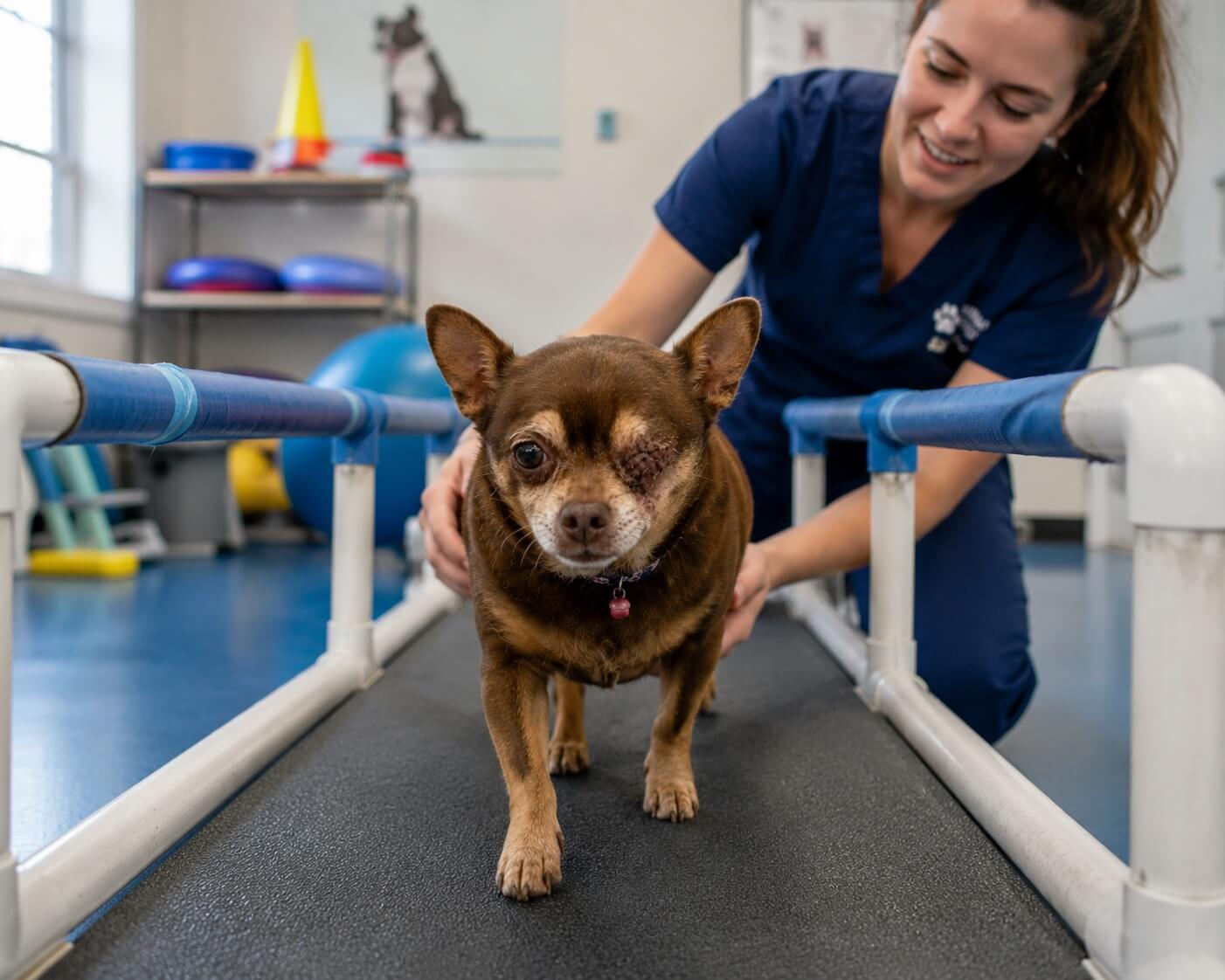
The rehabilitation team introduced carefully structured physical therapy sessions designed to help him regain mobility.
At first, standing seemed impossible.
His body had endured enormous trauma.
Every movement required effort.
Every step demanded concentration.
Still, he kept trying.
The rehabilitation staff never rushed him.
They celebrated every small improvement.
A few extra seconds standing.
A little more balance.
A little less hesitation.
The team knew Bruno couldn’t simply rest his way back to health.
Movement had become part of the recovery process.
Carefully supervised exercises helped protect healing bones while rebuilding strength that had disappeared during weeks of immobility.
According to VCA Animal Hospitals, “Physical activity minimizes muscle loss on the fracture limb, reduces the chance of long-term joint immobility, and speeds healing of the fracture.”
That principle guided much of Bruno’s rehabilitation.
Each carefully planned session helped him regain strength while supporting the healing process.
Then one unforgettable day, Bruno stood without assistance.
The room went silent.
Nobody wanted to interrupt the moment.
He remained standing.
A little shaky.
A little uncertain.
But standing.
After everything his body had endured, it felt almost impossible.
Then came another milestone.
His first independent steps.
The rehabilitation team watched closely as Bruno slowly crossed the room.
One step.
Then another.
Then another.
The walk wasn’t graceful.
It didn’t need to be.
For a dog who had once been unable to lift his own head, every step felt like a victory.
Recovery wasn’t happening in weeks anymore.
It was happening right in front of them.
And before long, Bruno would remind everyone of something they had almost forgotten.
He wasn’t just recovering.
He was learning how to be a dog again.
The Moment Everyone Had Been Waiting For
One morning, a volunteer arrived carrying a tennis ball.
It wasn’t part of a therapy session.
It wasn’t planned.
She simply happened to have it with her while visiting Bruno.
At that point, he had already made tremendous progress.
He was walking again.
His confidence had returned.
His tail seemed to have a mind of its own.
Still, nobody expected what happened next.
The volunteer rolled the tennis ball gently across the floor.
The ball bounced once.
Then twice.
For a split second, Bruno simply watched it.
The room fell quiet.
Several staff members looked over.
Then something remarkable happened.
Bruno chased it.
Not quickly.
Not perfectly.
His movements still carried traces of everything he had survived.
But none of that mattered.
He was chasing a tennis ball.
For the first time in months, he wasn’t a patient.
He wasn’t a trauma case.
He wasn’t a dog recovering from devastating injuries.
He was simply a dog having fun.
The room erupted with cheers.
People laughed.
Some wiped away tears.
Others stood frozen, watching a moment they once feared would never arrive.
That tennis ball traveled only a short distance.
Yet it represented thousands of hours of care, countless medical decisions, and an extraordinary amount of determination.
Most of all, it represented hope.
Because a dog who had once been unable to lift his head was now choosing to play.
And that changed everything.
A Different Dog Began to Emerge
As Bruno’s body healed, something else became impossible to ignore.
The sadness that once lingered in his eyes had started to disappear.
Confidence slowly took its place.
The fearful dog who arrived at the hospital barely clinging to life became one of the friendliest faces at the rescue facility.
Visitors quickly became his favorite part of the day.
Whenever someone approached his kennel, his tail began wagging almost immediately.
If they sat beside him, he would gently lean against them.
If they stopped petting him, he often nudged their hand for more attention.
It was hard to believe this was the same dog people once avoided.
The same dog strangers called frightening.
The same dog many judged before learning anything about him.
Bruno seemed determined to prove everyone wrong.
Not through anger.
Not through fear.
Through kindness.
The people who spent time with him learned something powerful.
The scars on his face never defined who he was.
They only revealed what he had survived.
Why Recovery Doesn’t End When the Injuries Heal
One thing many people don’t realize is that recovery often continues long after visible wounds disappear.
Bones can heal.
Surgical incisions can close.
Fur can grow back.
Building strength and confidence often takes much longer.
That was true for Bruno.
Even after walking returned, rehabilitation remained an important part of his journey.
Exercises helped strengthen weakened muscles.
Carefully managed activity improved balance and mobility.
Every week brought new progress.
Every month brought new possibilities.
Stories like Bruno’s show why rehabilitation has become such an important part of veterinary recovery programs.
The American Kennel Club says, “It can also promote faster recovery, reduce chronic pain and, most importantly, improve a dog’s quality of life.”
Looking at Bruno months after his accident, those words felt impossible to argue with.
He wasn’t just surviving anymore.
He was living.
And there is a huge difference between the two.
Finding the Family Who Saw Beyond the Scars
Eventually, Bruno reached a point every rescue hopes for.
He was healthy enough to leave.
His surgeries were behind him.
His rehabilitation was progressing well.
His future finally looked bright.
Only one thing remained.
Finding a family.
A real family.
The people who cared for him knew the right home would need something special.
Not because Bruno was difficult.
Because they needed someone willing to see beyond his appearance.
The scars were still there.
Some always would be.
The right family wouldn’t focus on them.
They would focus on him.
Fortunately, that family wasn’t far away.
A couple visited the rescue after hearing Bruno’s story.
Like many people, they noticed the scars first.
Then they met him.
And everything changed.
Bruno walked directly toward them.
He didn’t hesitate.
He didn’t seem nervous.
He calmly approached the woman and rested his head against her leg.
Then he stayed there.
Perfectly still.
Almost as if he had already made up his mind.
The connection was immediate.
Nobody in the room needed an explanation.
Sometimes the right match is obvious from the beginning.
This felt like one of those moments.
Days later, the adoption papers were signed.
Bruno’s long wait was finally over.
For the first time in a very long time, he left a building carrying something more powerful than medication, bandages, or medical records.
He left carrying a future.
Where Bruno Is Today
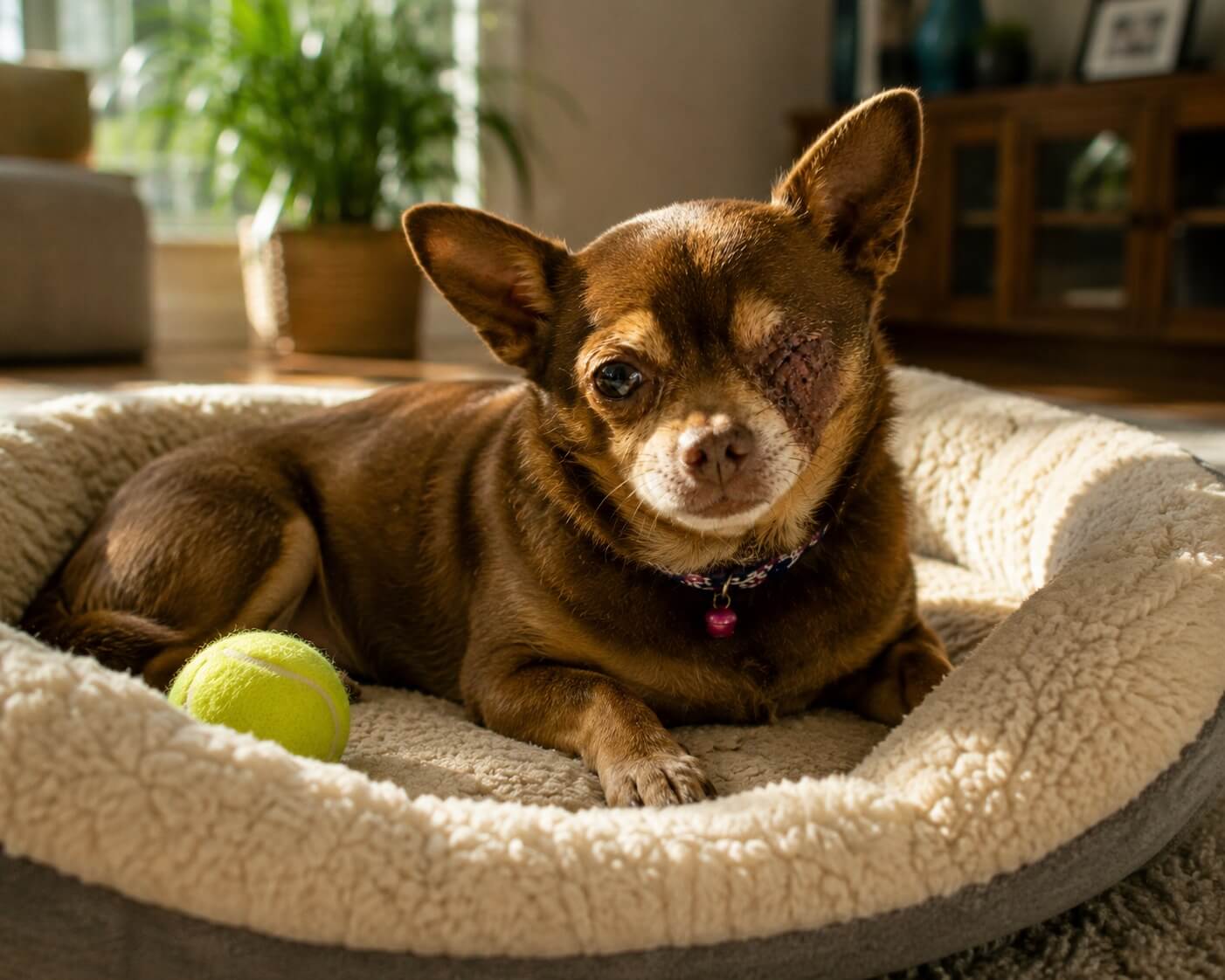
Today, Bruno spends his days doing the things every dog deserves to do.
He sleeps on oversized beds.
He stretches out in sunny spots around the house.
He follows his family from room to room, always wanting to be nearby.
Tennis balls remain one of his favorite things in the world.
His family jokes that he never quite outgrew the excitement of that first game.
Visitors who meet him often notice the scars.
Most people do.
Then Bruno introduces himself.
A wagging tail.
A gentle lean against their leg.
A request for ear scratches.
And suddenly the scars become much less important.
The dog behind them takes over.
That is usually the moment people understand what his rescuers learned long ago.
Bruno was never a monster.
He was a survivor.
The Lesson Bruno Leaves Behind
It is easy to judge what we see.
People do it every day.
A scar.
A disability.
A face that looks different from what we expect.
Those things often become the entire story in our minds.
Bruno’s life is a reminder that appearances rarely tell the whole truth.
The dog people feared most turned out to be one of the gentlest dogs anyone had ever met.
The face that made strangers uncomfortable belonged to a dog who wanted nothing more than affection.
The scars that caused people to look away became proof of extraordinary resilience.
His story isn’t really about a highway accident.
It isn’t about surgeries or rehabilitation.
It isn’t even about survival.
It is about second chances.
The chance a truck driver gave him by stopping.
The chance rescuers gave him by refusing to quit.
The chance veterinarians gave him through months of treatment.
And the chance a family gave him when they chose to see past the scars.
Years ago, people crossed the street when they saw Bruno.
Today, he spends his evenings stretched across a soft bed, a tennis ball nearby, and a family who adores him only a few feet away.
The scars are still there.
They probably always will be.
But they no longer tell a story about suffering.
They tell a story about survival.
A story about resilience.
And proof that sometimes the animals people fear the most are simply the ones who have suffered the most.
If Bruno’s story touched your heart, please consider sharing it. Every share helps more people see that scars don’t tell the whole story, and that rescue dogs deserve a chance to be known for who they are, not what they’ve been through.
Also read:
Left to Fade in the Street, Lola’s Quiet Fight for Life Is Now Giving Hope to Thousands
She Waited Outside a Supermarket for Days. What Happened Next Changed Her Life


