
Golden Retriever vs Labrador Retriever: Which Breed Fits Your Lifestyle Better?

This comparison is for real life, not for a fantasy version of dog ownership.
If you live in an apartment, juggle work hours, have kids, or this is your first dog, choosing between a Golden Retriever and a Labrador Retriever comes down to how your days actually look, not how the puppy phase feels. Both breeds are popular for good reasons. Both can also feel overwhelming once routines slip and expectations clash.
I learned this the slow way. I grew up around retrievers and assumed love and good intentions would carry me through. They didn’t.
What mattered was how much time I could give, how consistent my schedule stayed, and how prepared I was for the messy middle between puppyhood and adulthood.
This guide is meant to help you avoid that mismatch. You’ll see how each breed fits into real daily routines, where people tend to struggle, and what choices make life easier from the first month onward.
Let’s break it down.
A Quick Lifestyle Snapshot
Before getting into details, here is a snapshot many people wish they had seen sooner. This is not a verdict. It’s the context you can measure your own life against.
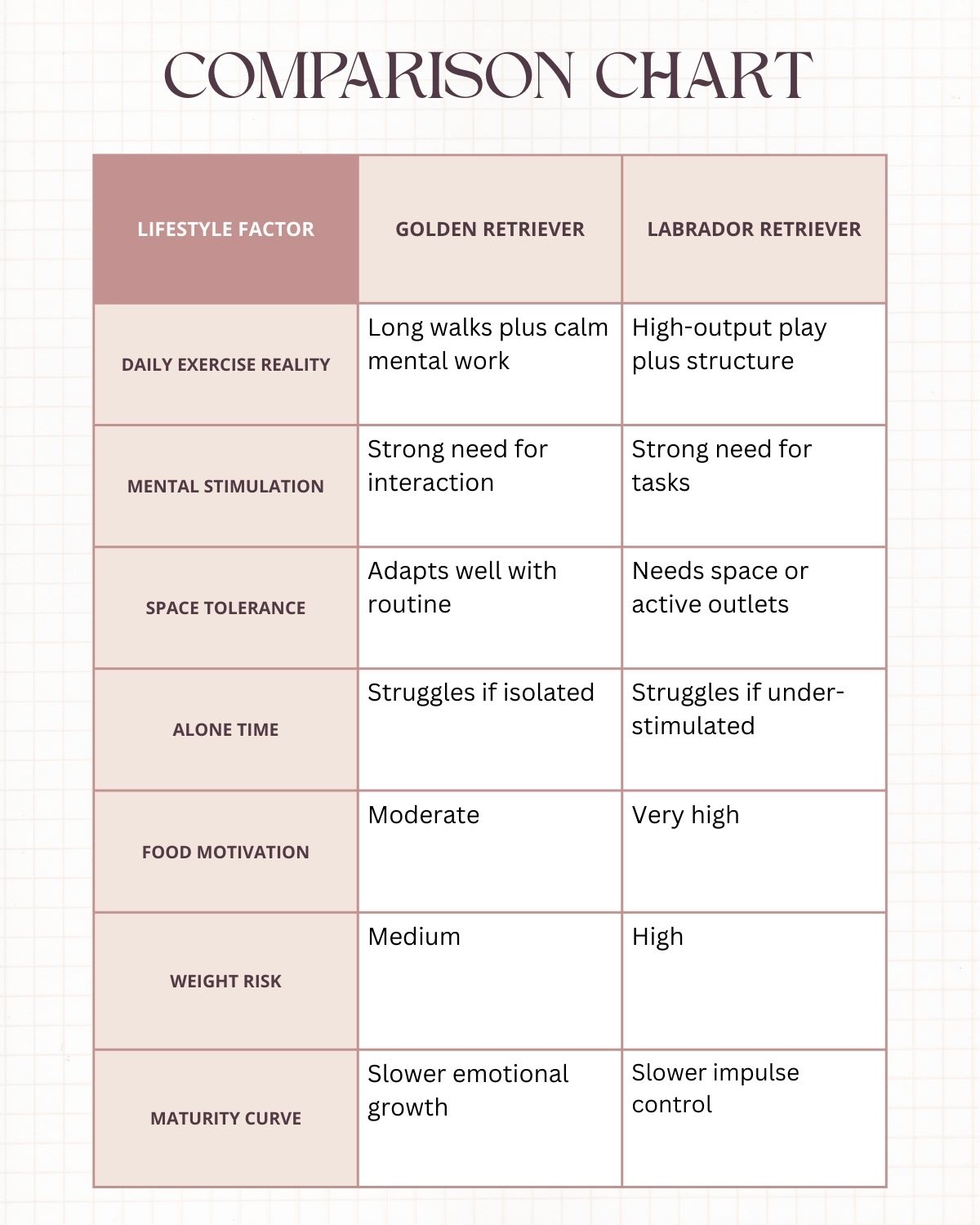
Most long-term issues show up when one of these rows is brushed off early. People don’t usually fail at dog ownership. They underestimate how small daily gaps add up.
As you read on, keep asking yourself where your current routine fits and where it might stretch.
Next, let’s talk about what your day actually looks like.
Energy Levels and the Reality of a Normal Day
Energy labels confuse more than they help. What matters is how energy shows up between breakfast and bedtime.
A Golden Retriever often starts the day wanting connection. A walk, a bit of training, some eye contact. When that box is checked, they tend to settle and stay nearby. When it isn’t, restlessness turns into shadowing, whining, or anxious behavior.
A Labrador Retriever starts the day wanting purpose. Fetch, structured play, scent work, swimming. Without an outlet, that drive doesn’t fade. It spills into pacing, grabbing objects, chewing, and bouncing off furniture.
I noticed this difference quickly in my own routine. On workdays, my Golden stayed relaxed after a solid walk and a short training session. My Lab needed focused activity before breakfast just to stay balanced for the rest of the morning. Skipping that step never went unnoticed.
Exercise still has limits. The Veterinary Genetics Laboratory at UC Davis explains that dogs affected by exercise-induced collapse can show weakness or collapse after as little as 5 to 20 minutes of intense activity, especially in breeds that push hard without pacing themselves.
That makes observation part of daily care, not something to think about later.
Action you can take today: Look at how your dog behaves one hour after exercise. Calm focus means you hit the mark. Wired chaos or shutdown means adjustment is needed.
This naturally leads into how training fits into everyday life, not just puppy classes.
Trainability and What Progress Looks Like Over Time

Both breeds learn fast. The difference lies in what motivates them and how long patience needs to last.
Golden Retrievers respond best when training feels like teamwork. They watch their people closely and adjust quickly when routines stay steady. House training and basic cues often fall into place early, but only when expectations remain calm and consistent.
Labradors respond best when training feels purposeful. Rewards, repetition, and movement keep them engaged. They often test limits longer, especially during adolescence, which catches many owners off guard. Calm does come, but it takes time and follow-through.
This is where expectations shape outcomes. Many first-time owners assume training ends after puppy classes. It doesn’t. Retrievers mature slowly, both emotionally and physically. What looks like stubbornness is often unfinished development.
Structure matters more than intensity. Short daily sessions. Clear cues. Predictable responses. When this stage gets rushed or skipped, behavior issues tend to linger.
Action you can take today: Pick one cue your dog already knows and practice it in three short moments across the day. Consistency builds faster than length.
That training foundation affects how behavior shows up next.
Behavioral Tendencies Without the Myths
Golden Retrievers are not endlessly gentle. Labradors are not permanently hyper.
Goldens tend to absorb their surroundings. Tension, noise, or unpredictable schedules often show up as withdrawal, clinginess, or anxiety. When leadership stays calm, they usually follow that tone.
Labradors tend to magnify their surroundings. Excitement turns louder. Movement turns faster. Without guidance, chaos grows quickly.
The Royal Kennel Club describes the Labrador temperament as biddable, eager to please, and steady when raised with structure. That balance develops through daily guidance, not wishful thinking.
Boredom looks different too. A bored Golden often pulls inward. A bored Lab pushes outward. Recognizing that difference helps owners respond instead of react.
Action you can take today: Watch how your dog behaves during quiet moments. Withdrawal calls for reassurance. Escalation calls for direction.
Those responses matter most when early mistakes creep in.
Common Owner Mistakes That Cause Issues Later

The most common mistake is choosing a breed based on childhood memories or social media clips. Puppies grow fast. Reality shows up slower.
Another mistake is brushing off health screening. The American Kennel Club outlines recommended health tests for Golden Retrievers and Labrador Retrievers, including hip and elbow evaluations and eye exams. Skipping proof of these checks raises the risk of long-term pain and expense. Their sporting breed health testing guide makes it clear what responsible breeding includes.
Weight is another quiet issue, especially for Labradors. Extra pounds add strain to joints and shorten comfortable mobility. The World Small Animal Veterinary Association offers a body condition score chart that helps owners judge health by shape, not guesswork. It’s a simple visual tool that often catches problems early.
Action you can take today: Run your hands along your dog’s ribs. Look for a visible waist. Cut treats in half and swap one play session for a calm walk.
These daily choices shape where and how your dog can live next.
Living Situation Fit: Apartment, House, or Somewhere in Between
Both breeds can live in apartments. Neither does well without routine.
Golden Retrievers tend to adjust to smaller spaces when walks, interaction, and quiet time stay consistent. They cope best when they know when attention is coming and when rest is expected.
Labrador Retrievers adjust when their need to move and work is handled outside the home. Without that outlet, confined spaces feel tighter fast. Restlessness shows up in pacing, noise, and grabbing anything within reach.
A yard helps, but it doesn’t replace engagement. Dogs don’t exercise themselves. A fenced space without structure often creates false confidence and real problems later.
Joint health also plays a role in how long a living space works. Cornell University College of Veterinary Medicine explains how hip dysplasia develops and why weight, growth rate, and exercise choices affect mobility in large breeds. Their guidance makes one thing clear. Early habits shape how comfortably a dog moves through its home years later.
If stairs, slick floors, or narrow hallways are part of your daily life, planning matters. Rugs, ramps, and controlled movement are not overthinking. They are preparation.
All of this leads to the question people quietly ask themselves.
Which Breed Fits Which Lifestyle
A Golden Retriever fits best if you value emotional closeness, predictable routines, and a home that stays calmer day to day. They thrive when presence matters more than pace.
A Labrador Retriever fits best if you enjoy activity, structure, and giving your dog a clear role in your routine. They do well when movement and direction are built into the day.
Neither breed fits a lifestyle with little time, little patience, or inconsistent follow-through. That gap causes most frustration, not the dog itself.
This is the part many breeders and posts don’t say out loud.
Choosing the Dog You Can Show Up For
Both breeds give back what you put in, no shortcuts included.
The right choice isn’t about which dog seems easier. It’s about which dog fits the life you already live, not the one you hope to grow into later. Dogs adapt, but they don’t erase gaps in time, energy, or planning.
When the match is honest, retrievers return loyalty, steadiness, and shared rhythm. When it isn’t, the mismatch shows up fast and stays loud.
Next steps: Look at your schedule. Look at your space. Be honest about both. Then choose the dog you can support every single day, even on the boring ones.
By this point, most readers know which breed feels closer to their life. What usually remains are the quiet doubts people hesitate to ask out loud. These questions show up again and again, especially from first-time owners or families trying to avoid regret later.
Let’s walk through them.
Frequently Asked Questions
Are Golden Retrievers or Labradors better for first-time dog owners?
Both can work for first-time owners, but the experience differs. Golden Retrievers often feel easier at the start because they respond quickly to calm routines and reassurance. Labradors can feel more demanding early on because they need direction every day. First-time owners usually do best when they choose the breed that fits their schedule, not their expectations.
Can either breed handle being left alone during work hours?
Neither breed handles long stretches alone well without preparation. Goldens tend to struggle emotionally and may become anxious. Labradors tend to struggle behaviorally and may act out. Gradual alone-time training, predictable routines, and mid-day breaks make a major difference for both.
Do Labradors really need more exercise than Golden Retrievers?
Labradors usually need more structured activity, not just longer walks. They benefit from tasks like fetch with rules, scent games, or swimming. Golden Retrievers still need daily movement, but their energy often settles faster when mental connection is met.
Which breed sheds more inside the home?
Both shed more than most people expect. Goldens shed year-round with heavier seasonal cycles. Labradors shed consistently with shorter hair that sticks to fabric. Regular brushing and floor care matter more than coat length when it comes to managing hair.
Is one breed healthier than the other long term?
Neither breed is automatically healthier. Long-term health depends on breeding practices, weight management, exercise choices, and early habits. Owners who focus on routine care, steady weight, and early screening usually see better outcomes regardless of breed.
If you’re still unsure, revisit the sections that matched your daily routine most closely. That’s where the answer usually sits.
Also read:
Best Dog Breeds for Apartment Living: What Actually Works for Noise, Space, and Energy
How Long House Training Really Takes (A Realistic Timeline by Age)


