
Abandoned for Growing Old, Murta Lost a Leg and Found the Family She Deserved
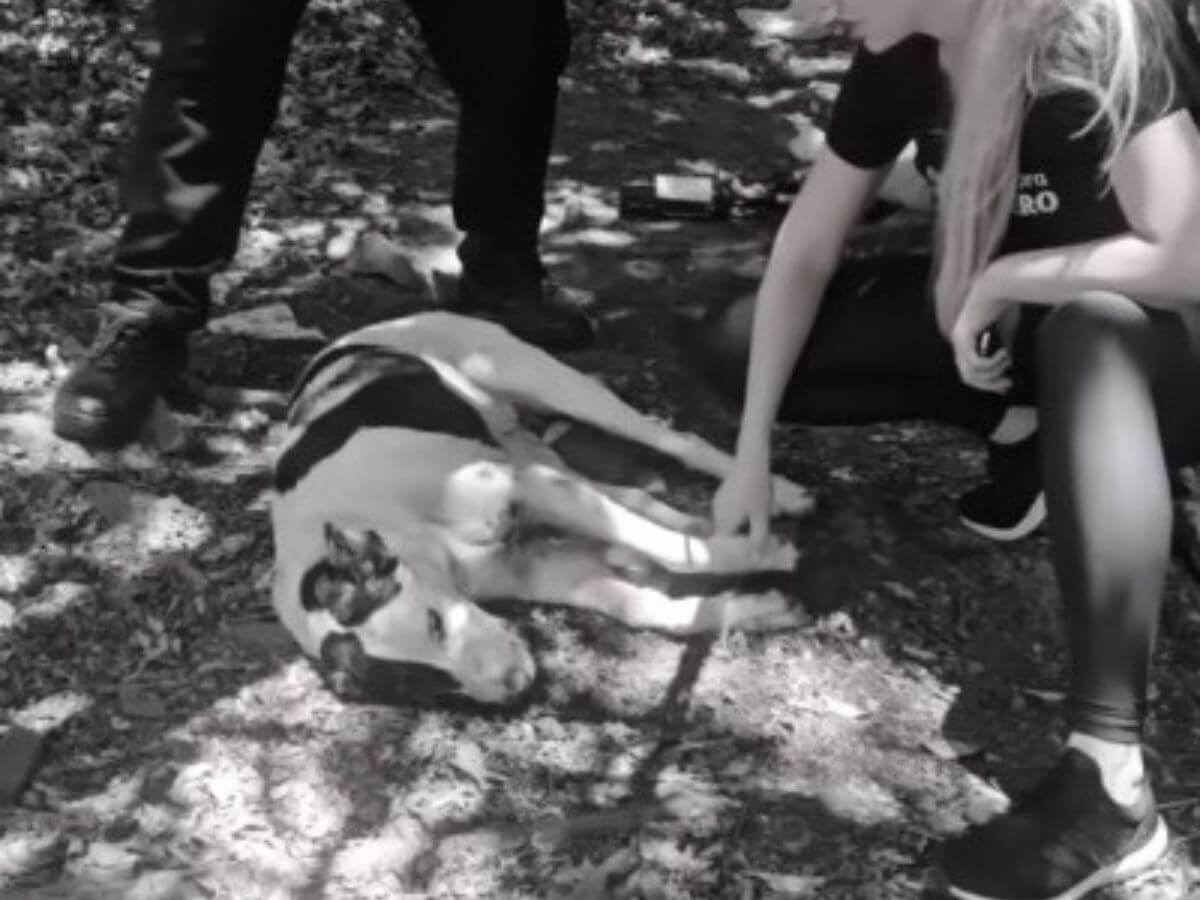
There are stories that shake you. Then there are stories that stay.
Murta’s is the kind that lingers long after you close the screen.
When rescuers first found her, she was barely able to move. Her body was thin. Her fur clung to open wounds. One front leg hung at an angle that told its own story before anyone spoke.
She was old. And she had been left behind.
The rescue was documented by Bruna Molz, the woman who pulled Murta from that suffering. When she later reflected on what she saw, she said, “There is nothing a dog could ever do that would justify cruelty.”
Standing over her frail body, that truth felt heavy.
Murta had likely spent years offering quiet loyalty. A warm presence in someone’s home. A shadow that followed from room to room. When her body weakened with age, protection should have followed.
Instead, she was left to endure pain alone.
What happened next was not just a rescue. It became a medical fight and a reminder of how senior dogs are too often overlooked.
A Loyal Life Met With Silence
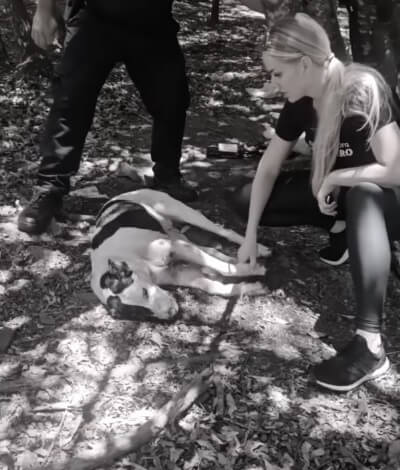
Rescuers have seen many injuries. This was different.
Her leg was shattered beyond repair. Deep wounds marked her skin. She did not resist when they approached. She did not growl or pull away.
She simply lay there.
Age makes dogs slower. It makes them softer. It should never make them disposable.
Yet senior dogs face a harsh reality inside shelters. According to the ASPCA, “It is a sad fact that senior pets are often the last to be adopted from shelters, putting them at an increased risk for euthanasia.”
That single sentence explains why dogs like Murta are at greater risk once their muzzles turn gray.
Older dogs may need more medical care. They may move slower. But they often give the deepest loyalty.
Murta did not just grow old. She grew unwanted.
Racing Against Time to Save Her Leg
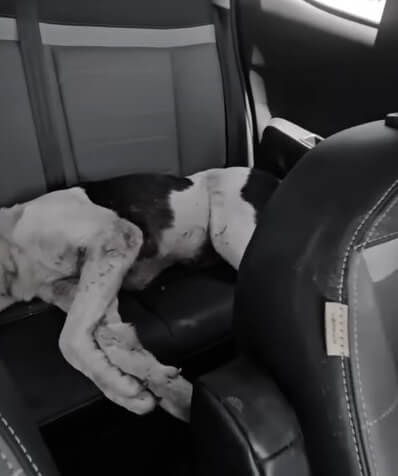
The team moved quickly.
They lifted her carefully, supporting the broken limb. At the clinic, veterinarians began cleaning wound after wound. Pain control came first. Stabilization followed.
Her shattered leg posed the biggest threat.
Severe fractures can cut off blood supply. Infection can take hold rapidly. Bone fragments can damage surrounding tissue.
The veterinary team attempted surgical repair. They aligned the fracture and gave her body a chance to heal.
For a short while, hope grew.
Days later, Murta stepped into a garden. Slowly. Carefully. The grass beneath her paws felt like proof that she might recover fully.
She took a few steps.
Everyone held their breath.
When Amputation Becomes the Only Option
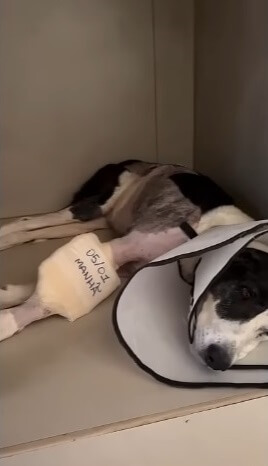
Healing does not always move forward.
Murta’s leg began to swell. Her body temperature rose. The bone refused to mend despite careful surgical work.
The infection threatened her life.
Veterinarians sometimes face decisions no one wants to make. The American College of Veterinary Surgeons explains that “Amputation may be recommended because of cancer, severe trauma, or a birth defect that has resulted in a non-functional leg.”
Murta’s leg had become non-functional.
To save her, the team made the decision to amputate.
It was not surrender. It was a medical decision made to save her life.
Before surgery, rescuers described a moment that stayed with them. Murta looked at them calmly. No trembling. No resistance.
According to Bruna Molz, “There was no fear in her eyes,” describing the moment before surgery.
She trusted the hands that were about to take part of her body to save the rest of it.
That trust speaks louder than any medical chart.
Learning to Live on Three Legs
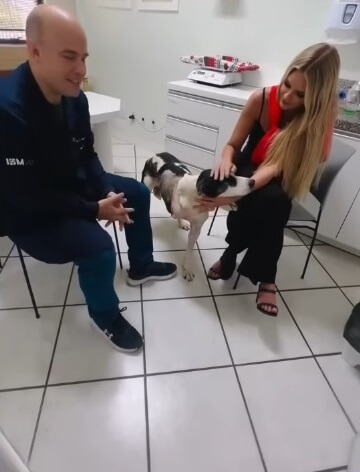
Amputation sounds devastating. For humans, it often is.
Dogs experience it differently.
They do not measure loss the way we do. They focus on what works. Once pain is removed and stability returns, their attention shifts to movement, balance, and comfort.
Murta’s progress did not happen in a single dramatic moment. It unfolded in small victories. The first steady stand. A cautious step forward. A slow turn without tipping. Each attempt built confidence.
Within weeks, she began moving with more certainty. Not perfectly. Not quickly. But willingly.
Front limb amputees naturally carry more weight on their remaining legs. That makes long-term joint health important. Maintaining a healthy weight reduces strain. Regular veterinary checkups help monitor mobility and catch early signs of stress in hips or shoulders.
What matters most is comfort and quality of life.
Murta was not defined by what she lost. Her spirit remained steady. Her trust remained intact. And once she realized she was safe, her body followed her lead.
The Reality Senior Dogs Face
Her story did not unfold in isolation.
Across the country, shelters continue to manage fluctuating adoption numbers. According to Shelter Animals Count, “In the first half of 2025, about 1.9 million dogs and cats were adopted nationwide—a slight 1% decrease compared to the same period in 2024.”
Even small decreases affect older dogs first.
Senior animals wait longer. Medical cases wait longer. Special-needs dogs wait longer.
Murta could have remained one of those waiting statistics.
Instead, someone chose her.
What Murta’s Story Means for You
Here is why this matters.
If you share your life with a dog, aging is part of the promise. Slower walks. Clouded eyes. Aching joints. These are signs of years shared.
Protection does not end when convenience does.
If you are considering adoption, do not overlook gray muzzles. Senior dogs often bring calm energy, clear personalities, and deep gratitude.
If you ever face a medical decision like amputation, seek veterinary guidance. Ask about prognosis. Ask about pain control. Ask about long-term mobility.
Sometimes removing a limb removes suffering.
Murta did not lose her worth when she lost her leg.
She gained safety. Warmth. Belonging.
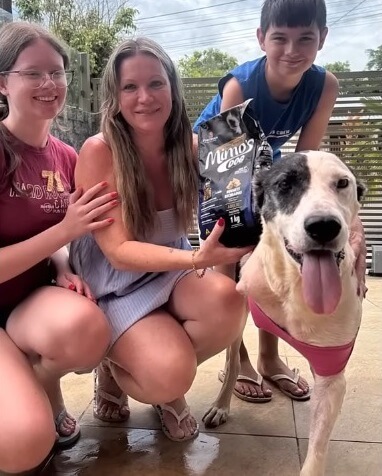
Today she leans into the family that chose her. Not once. Not conditionally.
Every single day.
Growing old is not a crime.
It is a privilege.
And every loyal companion deserves to experience it surrounded by love.
If Murta’s journey moved you, share her story. You never know who might choose a senior dog because they read this.
Related rescue stories you may want to read:
Helpless Puppy Vicente Escapes on Three Legs as Starving Vultures Close In
She Lay Frozen in Trash: What Santa Did Next Left Rescuers in Tears


