
Her Owner Tried to Give Up on Her But Violet’s Fight for Life Wasn’t Over
When Violet was carried into the emergency room, it was not under hopeful circumstances.
According to the rescue source Sky Sanctuary, Violet had been brought in at a point where her owner believed there was nothing left to do. Treatment was reportedly refused. Euthanasia was requested.
The medical team paused.
They looked at Violet more closely.
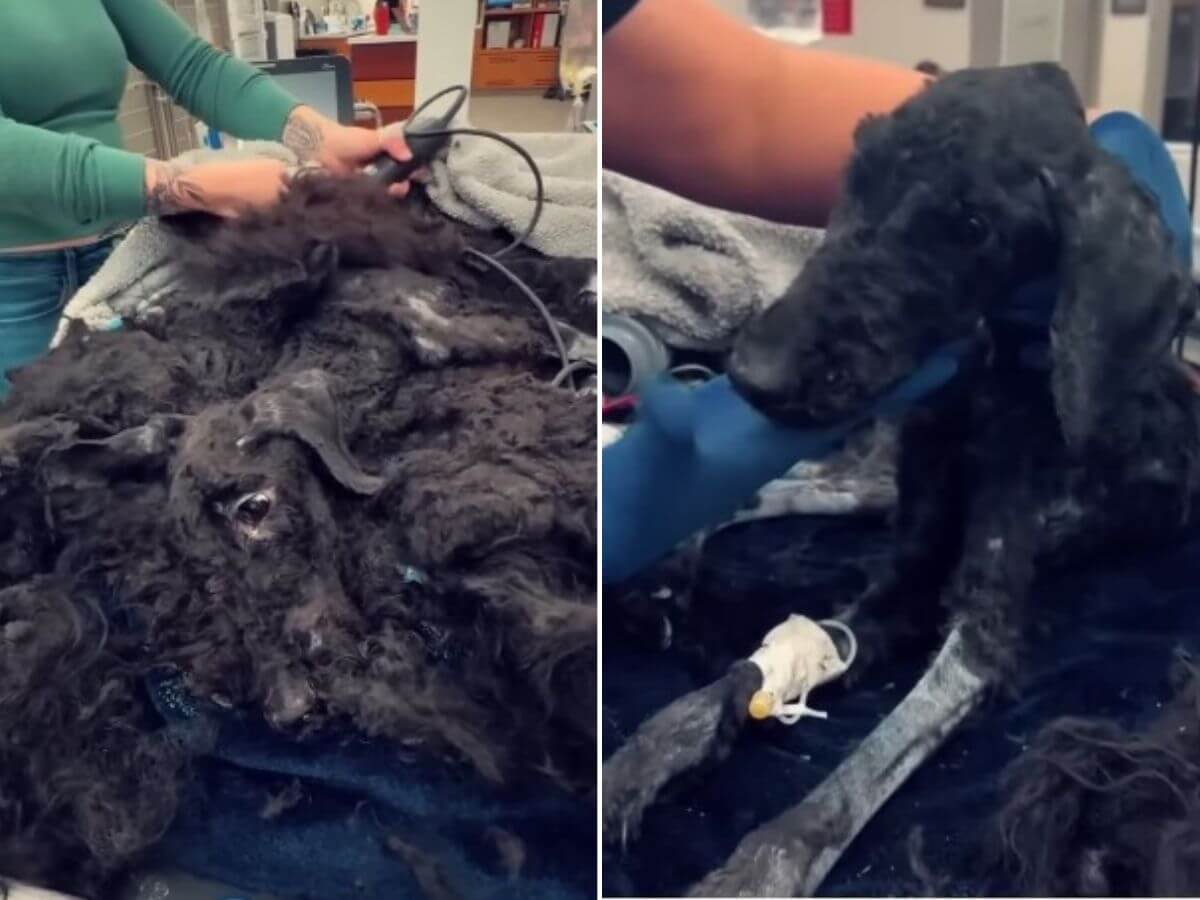
She was weak. Severely underweight. Barely responsive. Her fur hung in dense, tangled sheets around her body. Every sign suggested a dog at the end of her strength. But when they checked her vitals, something did not match the assumption that she was beyond saving.
There was still stability.
There was still possibility.
When staff indicated that authorities might need to be contacted, the owner left the facility.
Violet did not.
In that moment, the question shifted. Not whether she could be saved. But whether someone was willing to try.
A Body Shutting Down
In the hours that followed, the team began a full evaluation.
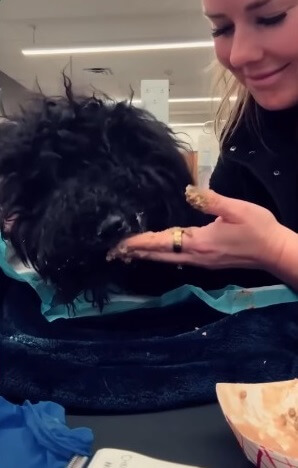
Violet could not lift her head. When food was offered, she lacked the strength to eat. Her breathing was shallow but steady. Her frame was painfully thin beneath the weight of her matted coat.
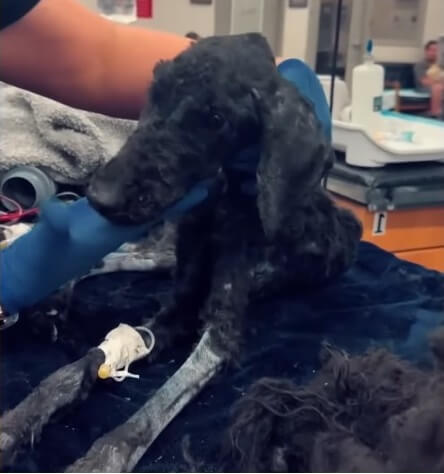
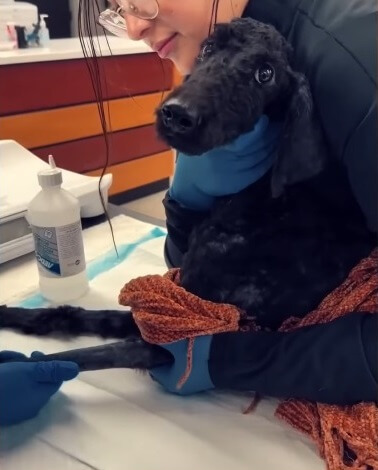
The fur was not simply unbrushed. It had hardened into compact layers that restricted her movement. According to rescuers, “It took a long time to cut her fur.”
What appeared cosmetic was medical.
The National Institutes of Health notes, “Chronically matted hair can contribute to and cause medical conditions such as skin irritation and infection,” underscoring that severe matting affects circulation, skin health, and mobility.
As the grooming continued, more of Violet’s condition became clear. Her muscle mass had deteriorated. Her weakness was not paralysis. It was prolonged depletion.
VCA Hospitals explains, “Hospitalized dogs can become malnourished due to decreased food intake, and this can lead to an immune system that doesn’t function well.” In Violet’s case, chronic underfeeding had likely weakened her body’s ability to recover.
The pattern aligned with what the ASPCA describes as “acts of neglect, such as failing to provide an animal with necessary food, water, shelter or veterinary care.”
Yet one detail surprised everyone in the room.
Her internal organs were functioning.
The damage was severe. It was not irreversible.
That distinction changed everything.
Choosing Treatment Over Goodbye
The team made a collective decision. They would stabilize her.
The first days required caution. Small portions. Fluids. Careful monitoring. Malnourished bodies must be reintroduced to nutrition slowly to avoid complications.
At first, there was little visible change.
Then she lifted her head.
The shift was subtle but unmistakable. Her eyes followed movement. She swallowed soft food. She responded to touch.
Recovery does not arrive dramatically. It arrives in increments.
Within weeks, she could sit upright without assistance. Shortly after, she stood for brief moments. Then came her first slow steps.
Each milestone was quiet. Each one mattered.
A Different Kind of Care
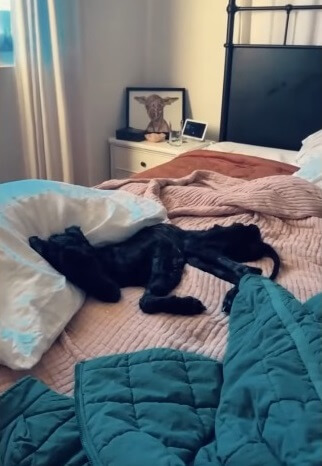
After stabilization, Violet was placed in a temporary foster home. The difference was immediate.
Warm bedding replaced cold surfaces. Meals arrived consistently. Human contact was gentle and predictable.
Rescuers later shared that in foster care she was “treated like a queen.” That meant routine, medical follow-up, and patience. Not indulgence. Stability.
Her weight increased gradually. Her coat grew back clean and manageable. Her energy returned in stages. Short walks replaced immobility. Curiosity replaced withdrawal.
There were no overnight miracles.
There was steady rebuilding.
Why Violet’s Story Matters
Neglect rarely looks dramatic from the outside. It can appear as delayed grooming. Inconsistent feeding. Missed veterinary visits.
By the time physical decline becomes obvious, the damage has often been building quietly. Severe matting can restrict movement and irritate the skin.
Chronic underfeeding weakens muscle mass and drains energy reserves. Over time, a dog’s body begins to shut down in small, gradual ways.
What makes cases like Violet’s difficult is that they can be mistaken for inevitability. A thin dog is assumed to be aging. A weak dog is assumed to be beyond help. A matted coat is dismissed as cosmetic.
It is not cosmetic. It is not inevitable.
Intervention matters. Early veterinary care matters. Consistent feeding and grooming matter.
Sometimes the difference between goodbye and recovery is not a miracle. It is a closer look.
Still Waiting for Forever

Today, Violet walks short distances. She eats balanced meals. She rests comfortably. She seeks affection.
Her foster placement gave her strength. What she still needs is permanence.
A home where her meals are predictable. Where her coat is maintained. Where veterinary care is routine.
Sky Sanctuary and the medical team chose evaluation over assumption. That choice gave Violet time. That time gave her a future.
If her journey stayed with you, share her story. The right family may be one click away from seeing her.
Sometimes a second chance begins because someone refused to say goodbye too soon.
You may also want to read:
She Waited Outside a Supermarket for Days. What Happened Next Changed Her Life
Left in an Oklahoma Dumpster, She Took One Wobbly Step That Changed Everything


